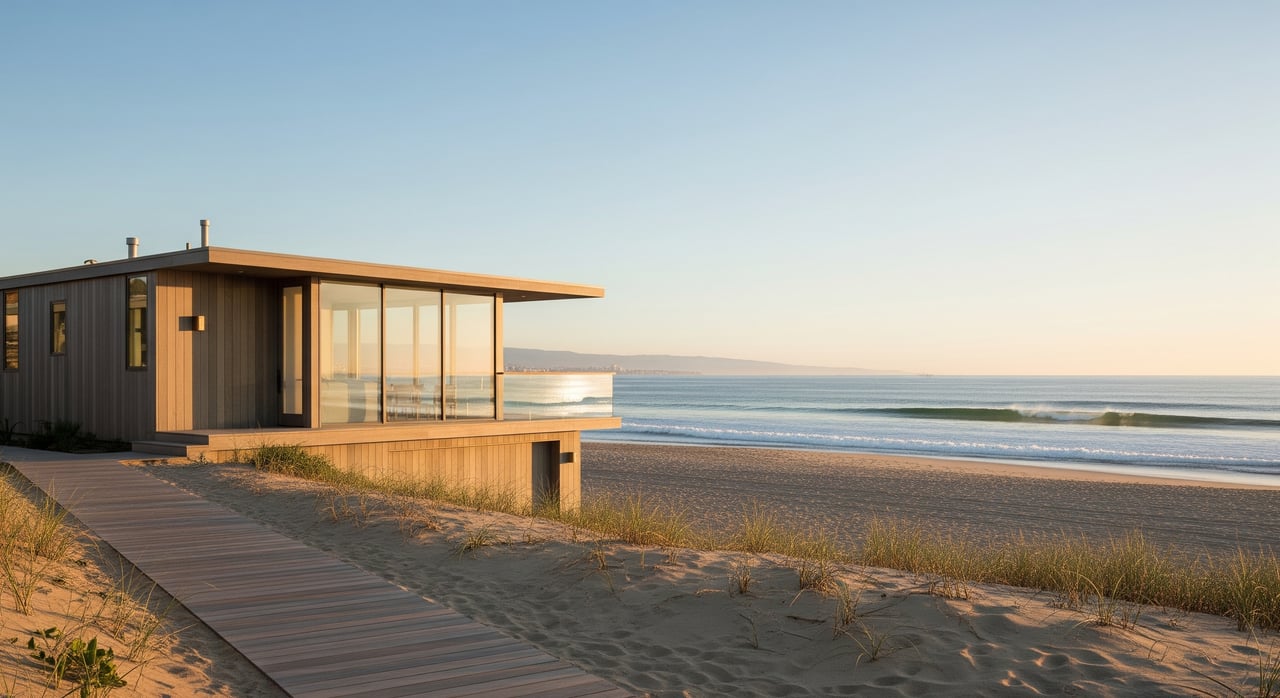
The nets go up before the sun does. By 5:30 a.m., regulars are already crossing the sand in front of the 2600 block of Ocean Front Walk, and by six the first serves are in the air. This has been the rhythm at the 14 courts of South Mission Beach for decades, ever since the original nets went up in 1965. Nobody wrote the 6 a.m. start time into any binder. It just worked, the way a lot of things in this neighborhood work, until this spring, when it almost stopped working at all.
The reason it almost stopped is the real story here, and it isn't really about volleyball. It's about how much of daily life in a place like Mission Beach runs on agreements nobody bothered to formalize, and how fast that can change once someone official actually reads the sign.
The Rule Was Never New
Here's what most people walking the boardwalk didn't know until this year: the courts were never legally open before 8 a.m. San Diego Municipal Code §59.5.0502 restricts excessive noise before 7 a.m., and city signage posted at the courts has for some time stated an 8 a.m. start. Regulars say the actual signs marking that hour went up about a year before enforcement began, sitting there through a full season without anyone stopping the sunrise games.
Then, in late April 2026, a city park ranger approached players and told them they could be cited for playing before 8. Nothing in the code had changed. What changed was that someone started reading it.
Players trace the shift to noise complaints from neighbors near the courts, including guests staying in short-term rentals along the boardwalk. That detail matters more than it looks: it means the rule wasn't reactivated by a policy decision. It was reactivated by a complaint, filtered through a code section that had been sitting dormant for a quarter century.
Fifty People, One Hour, No Music Before Nine
The community that showed up to defend the 6 a.m. start wasn't small. As many as 50 players arrive at the South Mission Beach courts daily, some as early as 5:30 a.m., many of them people whose work schedules make dawn the only window that exists. Volleyball player Sharon Hsia, who drives from Solana Beach to play, put it plainly.
"It's our sanctuary, our mental health, our therapy."
The players had already been policing themselves for years, with a self-imposed no-music-before-9-a.m. rule enforced by the group itself, not the city. Hsia went further, running a month-long sound study with a decibel meter that she says showed the ocean itself registers louder than the volleyball games. Whether or not that settles the argument, it reframes it: the dispute was never really about decibels. It was about whose long-standing routine gets treated as background noise and whose gets treated as a violation.
Not everyone on the sand agreed the enforcement was wrong. Gary Katz, a longtime Mission Beach resident whose home sits close to the courts, said the games carry directly into his house and have woken him at times. That's the tension this story sits inside: a group with a genuine 60-year claim to the sand, and neighbors with a genuine claim to quiet mornings, both right about their own experience of the same six a.m.
The Petition That Moved Faster Than City Hall
What happened next is the part worth remembering if you live here. Hsia launched a Change.org petition asking the city to formally move the start time from 8 a.m. to 6 a.m. It drew more than 1,000 signatures in under 12 hours. By August it had grown to nearly 3,000.
Joshua Daguman, co-owner of Life's a Beach Volleyball Club, took the fight directly to Mayor Todd Gloria, and by late July had a commitment that the issue was, in Daguman's words, at the top of the desk. On August 10, 2026, the city confirmed the decision: the allowable start time for beach volleyball would move from 8 a.m. back to 6 a.m., not just at South Mission Beach but at the city's other beach volleyball locations too, including the courts near Spray Street in Ocean Beach.
Here's the comparison that shows how much actually shifted, and how much didn't:
| Unofficial practice, pre-April 2026 | Enforced rule, April to August 2026 | Restored rule, effective Aug. 10, 2026 | |
|---|---|---|---|
| Start time | roughly 5:30 to 6 a.m. | 8 a.m. | 6 a.m. |
| Legal basis | none, honor system only | Municipal Code §59.5.0502 signage | Formal city decision, communicated to players |
| Where it applies | South Mission Beach's 14 courts | Same | Citywide, including Ocean Beach's Spray Street courts |
Four months of pressure won back two hours a day. For a group of people whose entire routine depends on getting one hour of play before a 9 a.m. shift, two hours is the difference between a sport and a memory.
The Fix Nobody's Talking About
Here's the part that didn't make most of the headlines: the win came with an asterisk. In July, the Mission Beach Town Council had conditioned its support for the earlier start time on relocating the two South Mission Beach courts closest to the boardwalk, moving them farther from the homes that back up to the sand. The city has since said it isn't pursuing that relocation.
So the compromise that ended the standoff addressed the hour on the sign. It didn't address the underlying geography that put homes and volleyball nets close enough to argue about in the first place. Hsia herself noted she was surprised the city moved forward given what she called mixed signals from the Town Council. The courts maintained by the local nonprofit San Diego BIG are staying exactly where they've been since 1965, which means the same proximity that generated the original noise complaints is still there, just operating on a schedule everyone has agreed to for now.
That's worth sitting with if you live near the boardwalk. Nothing about this resolution is permanent in the way a court ruling or an ordinance amendment would be. It's an understanding between a mayor's office and a volleyball community, the same kind of understanding that ran quietly for 25 years before a sign and a ranger interrupted it. The next short-term rental complaint, the next new resident who didn't grow up with the sound of a serve at 6 a.m., could reopen the exact same conversation.
Why This Is the Mission Beach Story Worth Knowing
Most visitors to this stretch of boardwalk see the courts as scenery, something to glance at on the way to the water. If you actually live here, they're closer to a clock. The 6 a.m. crowd is a fixture the same way the Green Flash at sunset is a fixture, or the way certain lifeguard towers have stood in certain spots for as long as anyone can remember. This spring proved how thin the ground under that kind of fixture can be, and how much organizing it took from Vejar, Hsia, Duran, and dozens of others to hold their ground.
The courts are still there. The nets still go up before six. But the arrangement holding that in place is a conversation, not a law, and conversations can restart.
If you're watching how Mission Beach handles the friction between its long-running routines and its changing mix of full-time residents and short-term guests, that tension shows up in more places than the sand. It shows up in how a block adjusts to a new rental next door, how a buyer weighs proximity to the boardwalk against proximity to a quiet block, and how a seller frames what daily life here actually feels like. If you want a neighbor's read on any of that, from someone who tracks Mission Beach as closely as the volleyball regulars track the tide, The Kaiser Team is a good place to start that conversation.